CULTURE
1 Read the texts on the opposite page. Which place would you most like to visit? Where should people go in London if they …
I would most like to visit Camden because I find alternative fashion and open-air street markets very exciting.
1 Hamleys on Regent Street (near Carnaby Street)
2 Camden
3 Westfield (in White City)
2 Are the sentences true or false? Correct the false sentences.
1 False. Most Oxford Street shops include typical high street brands, and the prices are quite good.
2 True.
3 True.
4 False. Carnaby Street is a pedestrian area, so there are no cars or traffic.
5 True.
6 False. Westfield does not have football fields; it is just the size of about 30 football pitches.
3 Match the highlighted words in the text to the meanings.
1 trendy
2 pedestrian
3 awful
4 huge
5 stalls
4 Listen to a report on teenagers’ shopping habits in the UK. Number the questions in the order you hear them.
5 Have you bought anything online in the last three months?
6 Where do you usually get the money from when you go shopping?
1 How often do you go shopping?
3 Do you count shopping as one of your hobbies?
4 Do you shop more in-store or online?
2 What do you buy when you go shopping?
5 Listen again and match the pie charts to five of the questions (1–6) in Exercise 4.
- Pie chart A matches Question 3 (Do you count shopping as one of your hobbies?).
- Pie chart B matches Question 5 (Have you bought anything online in the last three months?).
- Pie chart C matches Question 1 (How often do you go shopping?).
- Pie chart D matches Question 2 (What do you buy when you go shopping?).
- Pie chart E matches Question 4 (Do you shop more in-store or online?).
USEFUL LANGUAGE
6 Read the Useful language phrases. Complete them with the words in the box.
1 I’m doing a survey about shopping.
2 Can I ask you a few questions?
3 The first / next / last question is …
4 Can you give me an example?
5 An amazing 80% said yes!
6 This really surprised me.
PROJECT
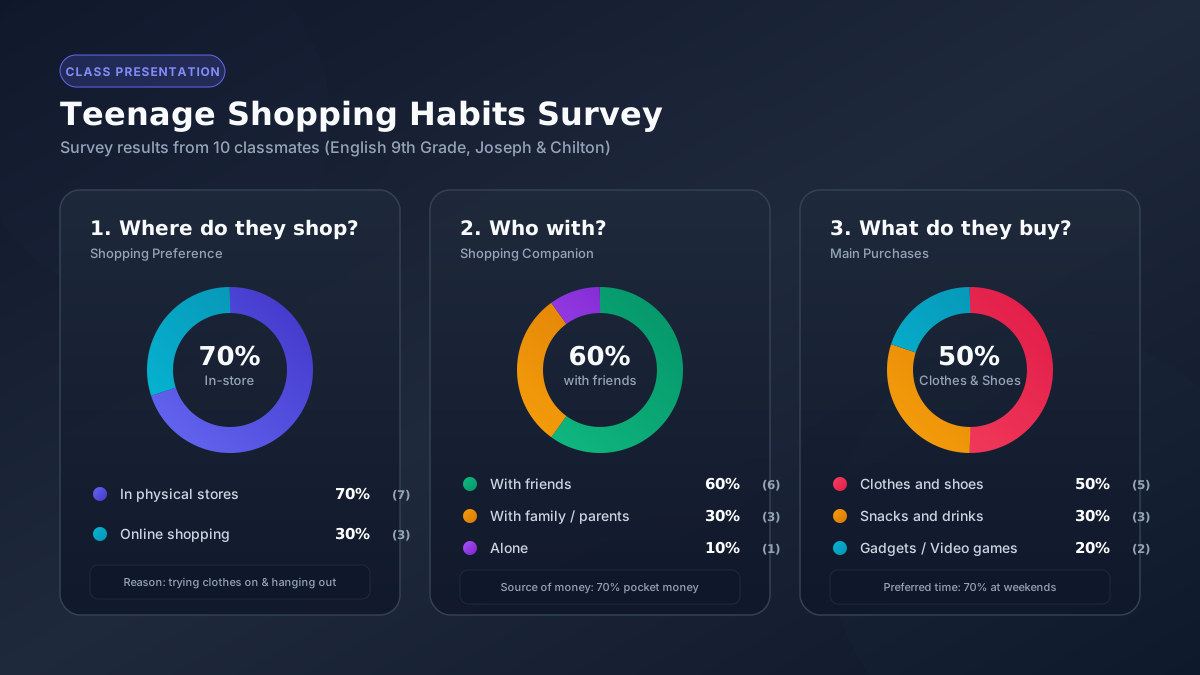
Create a survey to interview your friends about their shopping habits. Write questions about the topics below and your own ideas. Interview at least 10 friends and take notes. Make pie charts and present your results to the class.
Survey Questions:
1) Who do you usually go shopping with?
2) How often do you go shopping?
3) Where do you usually get your money for shopping?
4) Do you prefer to shop online or in-store?
5) What things do you usually buy when you go shopping?
6) How much money do you spend in a typical week?
7) When do you usually go shopping?
Survey Results (10 Teenagers Interviewed):
| Question | Options & Results |
|---|---|
| 1. Shopping companion | With friends: 60% (6) With family: 30% (3) Alone: 10% (1) |
| 2. Shopping frequency | Once a week: 50% (5) Every two weeks: 30% (3) Once a month or less: 20% (2) |
| 3. Source of money | Pocket money / allowance: 70% (7) Presents / gifts: 20% (2) Part-time job: 10% (1) |
| 4. Shopping preference | In-store: 70% (7) Online: 30% (3) |
| 5. Main items bought | Clothes and shoes: 50% (5) Snacks and drinks: 30% (3) Gadgets / Games: 20% (2) |
| 6. Weekly spending | Under ₴200: 40% (4) ₴200–₴500: 40% (4) Over ₴500: 20% (2) |
| 7. Preferred shopping time | At weekends: 70% (7) After school on weekdays: 30% (3) |
Class Presentation:
I am doing a presentation about the shopping habits of ten of my classmates. The first question was about who they shop with, and an amazing 60% said they prefer going with friends. When asked where they get their money, 70% replied that they rely on pocket money from their parents. This really surprised me: 70% of my friends prefer shopping in physical stores rather than online because they like trying on clothes and hanging out together. Finally, clothes and snacks are the most popular items bought, mostly during the weekends.